
Our solutions

Automatically generate and optimize your AI

SaaS, on-premise or expert support: our solutions automatically generate or optimize robust, custom AI models for every business challenge, with or without in-house expertise. They address the four key challenges of AI in production: model obfuscation, bias counterfight, data drift and optimization.

Efficient, secure, resilient and evolving AI

The native fitness score used to select the best models in competition (by default based on the validation error rate) can be enriched by your data scientists — confusion matrix, third-party model-stress tools and more. As a result, the predictions of generated models gain robustness and lose fragility through model competition.

Problem → solution

A solution answers a problem

Each of the challenges presented on the home page finds its answer in our evolutionary engine of mutation, competition and selection.

Obfuscation icon: masked model signature

Model obfuscation

The problem

An open-source model deployed as-is is identifiable: its topology and behavior form a recognizable signature that adversaries can exploit — targeted attacks, reverse engineering, prediction of its reactions.

Our answer

Mutations produce a topology that is no longer the original one, and selection keeps mutants that do not make the same errors as the initial model: the structural and behavioral signature disappears. Ensembling mutants blurs the behavior even further, and formal-validation tools (such as Numalis) make it possible to keep only fully validated models. Available as SaaS — which only ever sees the topology, never the weights or the data — or as an on-premise offer for the most sensitive environments.


Read the whitepaper (PDF)

Bias counterfight icon: balance and selection

Bias counterfight

The problem

Unwanted biases (demographic, historical, sampling) silently settle into models and create regulatory risk — reinforced by the European AI Act — as well as ethical and commercial risk.

Our answer

Your anti-bias criteria are built into the selection score: models carrying the biases you want to avoid are eliminated from the competition, generation after generation. Ensembling models with different biases also enables consensus-based decisions.

Data drift icon: changing data trend warning

Data drift

The problem

Your data evolves, your model does not: its performance silently degrades until an incident occurs, and manual retraining always comes too late.

Our answer

The evolutionary mechanism mutates the model at the pace of your data: with every dataset variation, competition re-selects the architectures best adapted to the new context, continuously.

Optimization and efficiency icon: performance gauge

Optimization and efficiency

The problem

Oversized models, LLMs that are costly to fine-tune and serve, consumption and latency incompatible with edge deployment or scaling.

Our answer

Multi-objective selection (score, parameter count, speed, consumption) produces smaller, leaner models at equal performance: mini-LLMs, distillation, edge models. For LLM fine-tuning, RAISE optimizes the adaptation layers added to the foundation model — the base model itself stays frozen.

Where does RAISE fit in the data scientist's job?

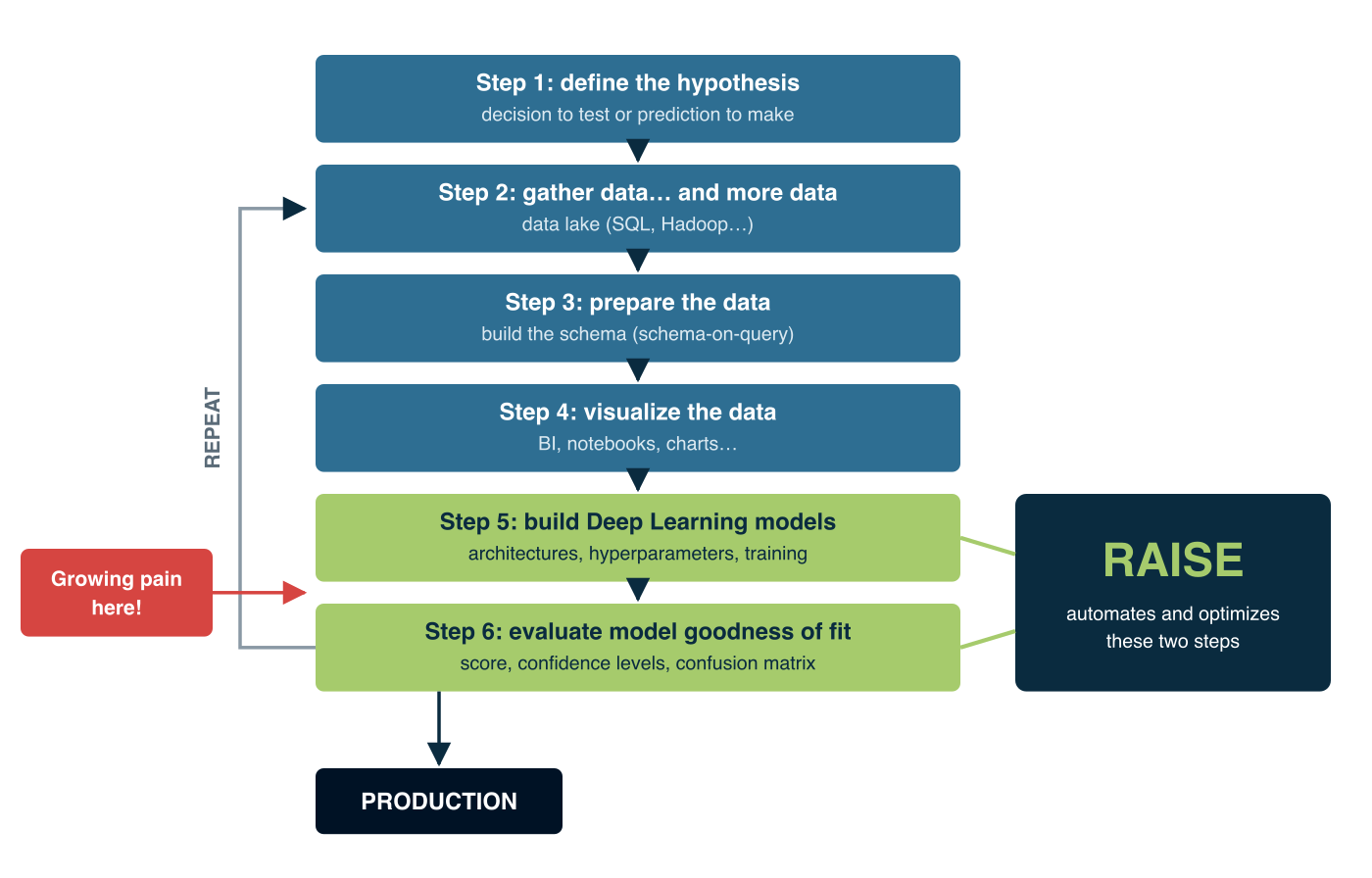
The data science process gets stuck at steps 5 and 6: building and then evaluating Deep Learning models. Still handcrafted, they are repeated in a loop at every iteration — this is where the pain grows. RAISE automates precisely these two steps: architecture exploration and evaluation against your criteria, all the way to a champion ready for production.

Diagram of the 6 steps of the data science process: RAISE automates step 5 (building Deep Learning models) and step 6 (evaluating model quality), before production

Generate and optimize your AI automatically

RAISE automatically generates a Deep Learning model tailored to your data — or optimizes the topology of an existing model — without taking anything off your premises, and delivers it in the standard Keras format, ready to use.

  1. Install the connector on your compute server
  2. Configure the connector to use your dataset
  3. Set the objective you want to reach
  4. Launch model generation
  5. The model is generated automatically
  6. Retrieve your model in the standard Keras format, ready to use

Basic knowledge of Python is recommended.

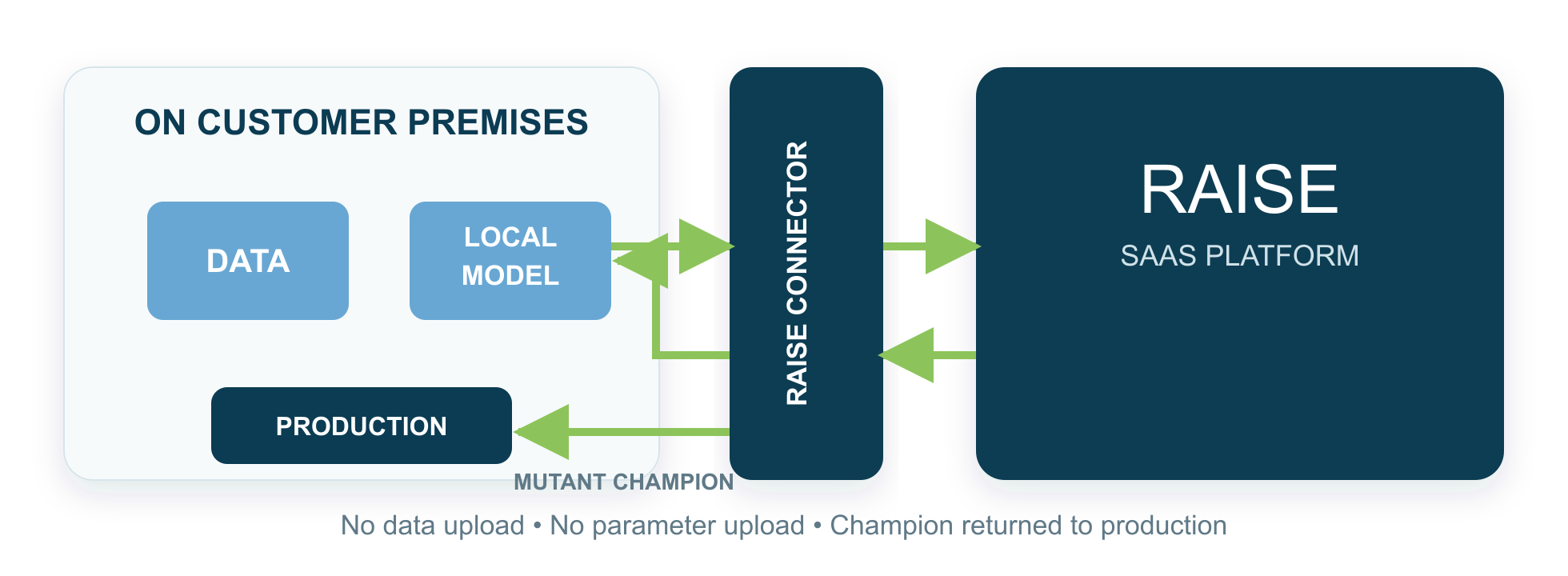
Functional diagram of AI generation with RAISE: data stays on-premise, models in the cloud

Three ways to work with us

RAISE as SaaS

The RAISE platform drives the evolution of your models from our cloud: you install the connector on your compute server, your data and model weights stay with you — only topologies and scores are exchanged.

On-premise deployment

For the most sensitive environments (isolated networks, air gap), the entire evolution engine deploys inside your infrastructure, with no outbound flow.

Expert support

Our experts support you end to end: problem framing, definition of the score and constraints, evaluation campaigns (robustness, bias, obfuscation) and skills transfer to your teams.

Guaranteed data confidentiality

Your data stays with you. Communication is always initiated from the client to the server, never the other way around: only model topologies and their scores are exchanged — never your data or the weights. We cannot identify your use case.

Compatible with your frameworks

  • TensorFlow / Keras
  • PyTorch
  • ONNX

Deep Neuroevolution in action

Discover how our technology works and how RAISE generates your models.